How to Choose the Perfect Bed Base That Supports Your Mattress and Fits Your Room
A lot of people shop for a mattress like it is the whole sleep setup, then treat the bed base as an afterthought. That is usually a mistake. The base under the mattress affects support, airflow, durability, bed height, storage, ease of movement and sometimes even whether the mattress warranty remains valid. It also changes how the bed feels in daily use: whether it squeaks, traps heat blocks drawers or makes a small room feel cramped.
Modern manufacturers are increasingly clear on this point. Sealy says modern mattresses need a stable non yielding platform and major brands including Tempur-Pedic and Sealy specify slat rules such as roughly 3-inch-wide slats spaced no more than 4 inches apart for many models. Sleep Foundation also notes that warranties often require a supportive base and that average mattress warranties typically run 10 to 20 years which makes the support decision more important than it first appears.
The timing matters too. Sleep is not a soft lifestyle topic anymore it is increasingly treated like a performance and wellbeing issue. In the National Sleep Foundation’s 2025 Sleep in America poll 90% of adults said enough sleep positively affects work productivity and 87% said it positively affects productivity at home.
IKEA’s 2025 global sleep report, based on 55,221 people across 57 markets found a global gap of 1 hour and 20 minutes between the sleep people want and the sleep they actually get. When sleep has that kind of everyday impact, the structure underneath your mattress deserves more attention than whatever looks nice online.
Room fit is becoming just as important as mattress support. In England the 2024–25 English Housing Survey estimated about 824,000 households were living in overcrowded conditions, while the private rented sector has shifted toward smaller homes with one-bedroom homes rising from 18% in 2019–20 to 21% in 2024–25.
At the same time, people are still spending meaningful money on beds: the National Bed Federation’s 2025 consumer survey found the average price paid for a mattress rose 8.4% year over year to £645 and super king purchases doubled from 5% to 10%. In other words, people are buying bigger and better sleep products while many bedrooms are not getting bigger with them.
Why the bed base matters more than most buyers think
A bed base does two jobs at once. First it distributes weight so the mattress can keep its intended feel and alignment. Second it determines how the bed behaves in the room: height, storage visual bulk airflow and accessibility.
If the base flexes too much, has weak center support or leaves slats too far apart the mattress can sag earlier than expected or feel softer in the middle than it did in the showroom. Sealy’s guidance is blunt: modern mattresses need a stable platform that does not yield under pressure. Serta also warns that sagging and unevenness can happen when the frame or foundation is not supporting the mattress properly.
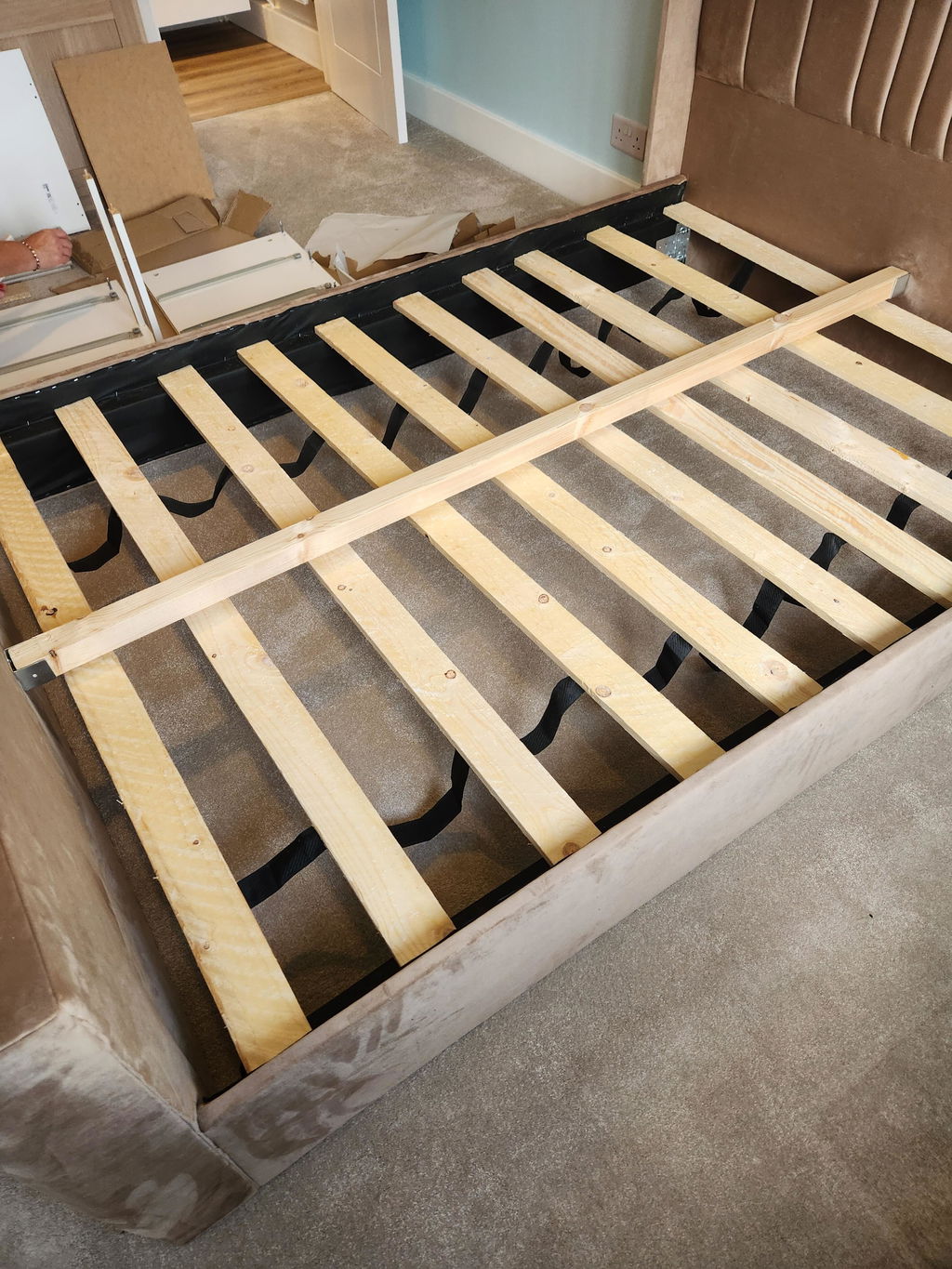
Support details are not just technical fine print. Tempur Pedic and Sealy both state that slatted bases can work but only when the slats are structurally sound about 3 inches wide and no more than 4 inches apart.
For larger sizes, support underneath the frame matters too Sealy and Tempur-Pedic both specify that queen, king and California king setups need center support and Sealy’s warranty language requires at least five legs for those larger sizes. That is why two bed frames that look almost identical online can perform very differently once real body weight hits the mattress night after night.
Start with your mattress type not the furniture style
The fastest way to choose the wrong base is to begin with aesthetics. Start with the mattress first, then narrow the base style.
-
Memory foam, latex, and most hybrids: Usually work best on a flat foundation or a well-built slatted base with narrow spacing. Sleep Foundation notes that slats can work especially well for memory foam, latex and hybrid mattresses, while the gaps also improve airflow.
-
Traditional innerspring mattresses: Often pair well with a box spring because box springs were originally designed for coil based mattresses. That said, some modern innersprings also work on slats or flat foundations so the manufacturer’s compatibility rules still win.
-
Adjustable-base setups: Usually need a flexible mattress. Sleep Foundation says foam, latex, airbed and many hybrid mattresses are commonly compatible with adjustable beds and Tempur-Pedic states that its mattresses are compatible with its power bases.
The practical takeaway is simple if you buy a foam or latex mattress and place it on an old-school springy box base just because you already own it you may be undoing the benefit of the mattress itself. Conversely if you buy a traditional coil mattress for a guest room and want extra bed height a compatible box spring can still make sense. Compatibility beats trend-following every time.
Which bed base style is best for your room and lifestyle?
Slatted platform base
This is the most versatile option for modern buyers. A good platform base gives a low clean profile works with many modern mattresses and typically costs less than more feature heavy bases. It is especially strong for people who want a modern look, easier cleaning under the bed and decent airflow. Sleep Foundation notes that slats promote cooling airflow and can help prevent moisture buildup. That makes platform beds a strong all-rounder for many homes.
The catch is quality control. Platform bed is not a performance standard. Some have sturdy, closely spaced slats; others do not. If you choose this route the slat spacing and center support matter more than the marketing photos. A cheap platform base with wide slat gaps can be worse than a simpler but better-built foundation.
Divan or upholstered base
A divan-style or upholstered base is less visually airy, but often more efficient in compact bedrooms because it tends to align tightly with mattress dimensions instead of adding bulky side rails. That can matter in narrow rooms where every few centimetres count. The NBF’s 2025 survey found divan sets rose from 17% to 19% of purchases, and traditional divans remained especially popular among over-55 buyers. That suggests the category still wins when shoppers prioritize practicality, support and simple room planning over a lighter visual look.
This type of base is often a smart pick when you want a bed that looks finished, feels sturdy, and wastes very little floor area. In real homes, that often matters more than having exposed legs or a more architectural frame.
Ottoman or storage base
If the room is short on wardrobes an ottoman or storage base can solve two problems at once: sleep support and hidden storage. This is exactly why multifunctional furniture keeps gaining momentum. One 2025 industry analysis valued the global multifunctional furniture market at $15.9 billion in 2024 and projected 4.9% annual growth through 2034 driven partly by smaller living spaces and demand for flexible homes. That lines up with official housing data showing rising pressure on bedroom space in England’s rented stock.
The important nuance is clearance. A storage bed is only space saving if you can actually open it. Side drawers need room to pull out. Ottoman lift up models need enough overhead and side access for comfortable use. In a tight bedroom a lift up ottoman often works better than drawer storage because it uses vertical rather than lateral clearance.
Adjustable base
An Adjustable Mattress is not for everyone, but for the right buyer it is more than a luxury add-on. Sleep Foundation notes that adjustable beds can help by elevating the head or feet which may be useful for snoring, swelling, joint pain, limited mobility or reflux. They also suit couples who want different positions, especially in split configurations. The trade off is cost, weight and mattress compatibility. Most adjustable beds cost notably more than standard frames and require a mattress that can bend without damage.
For someone buying purely on design an adjustable base may be overkill. For someone who reads in bed every night, struggles with reflux or wants easier getting in and out of bed it can be the smartest long term choice in the category.
Measure your room like a planner not just a shopper
One of the best buying habits is to stop thinking only in mattress dimensions and start thinking in usable room geometry. England’s nationally described space standard sets a one-person bedroom at a minimum of 7.5 square metres and at least 2.15 metres wide, while a double/twin room should be at least 11.5 square metres with one double bedroom at least 2.75 metres wide. Related accessible housing guidance also uses a 750 mm clear access route from the doorway to the window and around key bed positions. Those standards are not a shopping template but they are a useful reminder that a bedroom has to function not just contain a bed.
Before you buy, measure these five things:
-
the full bed footprint, including headboard depth and side rails
-
total sleep height: base plus mattress, especially if you want easier entry and exit
-
walking clearance beside the bed, near wardrobes and at the foot of the bed
-
storage clearance for drawers or ottoman lift access
-
delivery route, including stairs, corners and door widths
A common real world failure looks like this: the bed technically fits wall to wall but the wardrobe door only opens halfway the bedside table has nowhere to go and the room suddenly feels like storage space with a pillow on top. Good bed buying avoids that outcome before checkout.
The mistakes that cause the most regret
The first mistake is buying a base for the photo instead of the mattress. Upholstered rails, floating silhouettes or oversized winged headboards can look impressive, but if the support system underneath is weak the bed will not feel premium for long. The second mistake is assuming slats are slats.They are not. A properly engineered slatted base and a flimsy one belong in different categories. The third mistake is forgetting about center support in queen and king sizes, where structural weakness shows up faster.
Another expensive mistake is matching a modern foam mattress with an old box spring without checking compatibility. Sleep Foundation notes that traditional box springs were designed for innersprings, while all foam and some latex models may sag or lose support on springy bases. Finally many buyers underestimate room behavior. A bed can be the correct size on paper and still be the wrong choice for the room once drawer swing, radiator position or circulation space are considered.
A simple buying checklist you can actually use
When comparing options, the best bed base is usually the one that gets six answers right:
-
Does the mattress manufacturer explicitly allow this base type?
-
Are the slats close enough together and strong enough for the mattress?
-
Does the frame have center support if you are buying queen or larger?
-
Does the height work for how you get in and out of bed?
-
Does the base save space or waste it in your specific room layout?
-
Will this still make sense in five years not just on delivery day?
If you cannot answer those confidently you are still shopping too early.
Conclusion
Choosing the perfect bed base is really an exercise in alignment: align the base with the mattress, the bed with the room, and the purchase with the way you actually live. The best base is not always the most expensive one, and it is rarely the one chosen on looks alone. It is the one that gives the mattress the support it was designed for, preserves your warranty, suits your room dimensions, and adds practical value through height, storage or adjustability.
FAQs
What is a bed base and why does it matter?
A bed base is the structure that supports your mattress. It matters because it affects comfort, mattress lifespan, airflow, stability and even whether your mattress performs as intended over time.
Can the wrong bed base damage a mattress?
Yes. If a bed base does not provide proper support, the mattress may sag, wear unevenly or feel less comfortable. In some cases, using the wrong base can also affect the mattress warranty.Which type of bed base is best for memory foam or hybrid mattresses?
Memory foam and hybrid mattresses usually work best on a solid platform base or a slatted base with closely spaced, sturdy slats. This helps distribute weight evenly and prevents the mattress from dipping between gaps.
How do I know if a bed base will fit my room properly?
Measure the full bed footprint, including the frame and headboard, not just the mattress size. You should also check walking space around the bed, wardrobe clearance, and whether storage drawers or ottoman lifts can open comfortably.
Are slatted bed bases better than solid bases?
Not always. Slatted bases can improve airflow and work very well for many modern mattresses, but only if the slats are strong and spaced correctly. Solid bases can offer firmer support, so the best choice depends on your mattress type and comfort preference.
Is a storage bed base a good option for small bedrooms?
Yes. Storage bed bases, especially ottoman styles are often a smart choice for smaller rooms because they combine mattress support with built in storage. This can reduce the need for extra furniture like drawers or chests.
What is the difference between a divan base and a platform bed?
A divan base usually has a more compact footprint and may include built in storage, making it practical for smaller rooms. A platform bed often has a more modern look with visible legs or slats, which can make a room feel lighter and more open.
Do I still need a box spring with a modern mattress?
In many cases, no. Most modern foam, latex and hybrid mattresses are designed for platform beds, solid foundations or compatible slatted bases rather than traditional box springs. Always check the mattress manufacturer’s recommendations first.
Are adjustable bed bases worth buying?
They can be worth it for people who want more comfort while reading, watching TV or dealing with issues like reflux, snoring, or mobility problems. However they are more expensive and require a compatible mattress.
What should I check before buying a bed base?
Before buying, check mattress compatibility, support quality, slat spacing, center support for larger sizes, room measurements, storage access, bed height, and delivery access through doors or stairs.