Bed Base Buying Guide: How to Choose the Right Foundation for Your Mattress
Buying a mattress gets most of the attention but the bed base underneath it often decides how that mattress actually feels, performs and lasts. A supportive mattress on a tired, uneven or incompatible base can still sag early, feel too firm or too soft or fail to give your body the pressure relief you paid for.
That matters because the UK is clearly paying more attention to sleep quality. YouGov found in 2024 that 77% of Britons would ideally like eight hours or more sleep a night yet 41% usually get six hours or less upgrading bedding for comfort was one of the most common actions people took to improve sleep quality, at 40%. Dreams’ 2024 UK Sleep Survey also found that people spend an average of 7.4 hours in bed but sleep for only around 6 hours, with physical discomfort becoming a growing cause of disturbed sleep.
So, choosing the right bed base is not just about furniture style. It affects spinal support, mattress durability, bedroom storage, delivery access and even warranty protection.
Why Your Bed Base Matters More Than Most Buyers Realise
A bed base is the foundation that spreads body weight, stabilises the mattress and controls how much give you feel underneath. Dreams describes bed bases as supportive foundations that help prevent sagging, improve stability and create a more even sleep surface.
The important detail is that a base does not work in isolation. It changes the behaviour of the mattress above it. A solid platform top usually makes a mattress feel firmer and more stable, while sprung slats or sprung edge divans can add a little cushioning. That is why the same mattress may feel different on a divan base, wooden frame, ottoman base or adjustable electric base.
A poor base can also shorten mattress life. Sleep Foundation notes that a strong support base helps a mattress retain its shape and reduces sagging risk, while inadequate foundations can cause internal damage or void some warranties. Fishpools also advises that an unsuitable base can affect mattress comfort, longevity and guarantee cover.
The UK Buying Trend: Better Sleep, Smaller Rooms and Smarter Storage
The modern UK bed base is doing more than holding a mattress. It is becoming a storage solution, design feature and long-term comfort investment.
The wider UK furniture market is estimated at USD 29.69 billion in 2026, with home furniture leading by application and premium furniture expected to grow faster than the economy tier through 2031. In mattresses specifically, the UK market is estimated at USD 1.45 billion in 2026, with king-size units accounting for 37.12% of market share in 2025.
Storage is also becoming a major buying driver. A 2026 bedroom storage report cited by Big Furniture Group found that 45% of Britons struggle to store clothes and belongings due to limited bedroom space, while 36% store belongings elsewhere in the home and 29% rely on boxes or bags. This explains why ottoman and divan storage bases are so practical for UK flats, terraces, box rooms and family bedrooms.
Main Types of Bed Base and Who Each One Suits
Divan Factory Outlet’s All Bases collection includes platform-top divan bases, reinforced bases, ottoman storage bases, hotel-style bases, low divan bases, split bases and adjustable electric bases, giving UK buyers several foundation styles depending on mattress type, room layout and storage needs.
|
Bed base type |
Best for |
Sleep feel |
What to check |
|
Platform-top divan base |
Everyday support, clean bedroom look, most mattress types |
Firmer and stable |
Works well if you want less bounce |
|
Sprung or slatted base |
A slightly softer or more flexible feel |
More responsive |
Slat spacing must suit the mattress |
|
Ottoman storage base |
Small rooms, flats, seasonal storage |
Usually firm and supportive |
Check opening direction and ceiling clearance |
|
Reinforced base |
Heavier mattresses, busy households, long-term durability |
Solid and stable |
Check weight guidance and construction quality |
|
Split divan base |
Narrow stairs, tight landings, older UK homes |
Same as standard base |
Confirm split sections match your mattress size |
|
Adjustable electric base |
Reading, TV, mobility support, pressure relief positioning |
Flexible and positionable |
Needs a compatible flexible mattress |
Platform-Top Divan Bases: The Reliable All-Rounder
A platform-top divan base is one of the most straightforward choices. It gives the mattress a flat, stable surface and is especially useful if you want a firmer, more controlled feel. It also keeps the bed footprint neat because the base is usually close to the mattress size.
Choose this if your priority is simplicity, support and a tidy upholstered look.
Ottoman Bases: Best When Storage Is the Real Problem
An ottoman base uses the space beneath the mattress as hidden storage. Unlike drawer bases, which divide the storage into compartments, an ottoman typically gives you access to most of the under-bed area.
For UK homes where wardrobes are already full, an ottoman base can replace extra storage furniture. Side-lift ottomans suit rooms where one side of the bed is clear. End-lift ottomans suit rooms where the foot of the bed is easier to access.
Slatted Bases: Good Airflow, But Check the Gaps
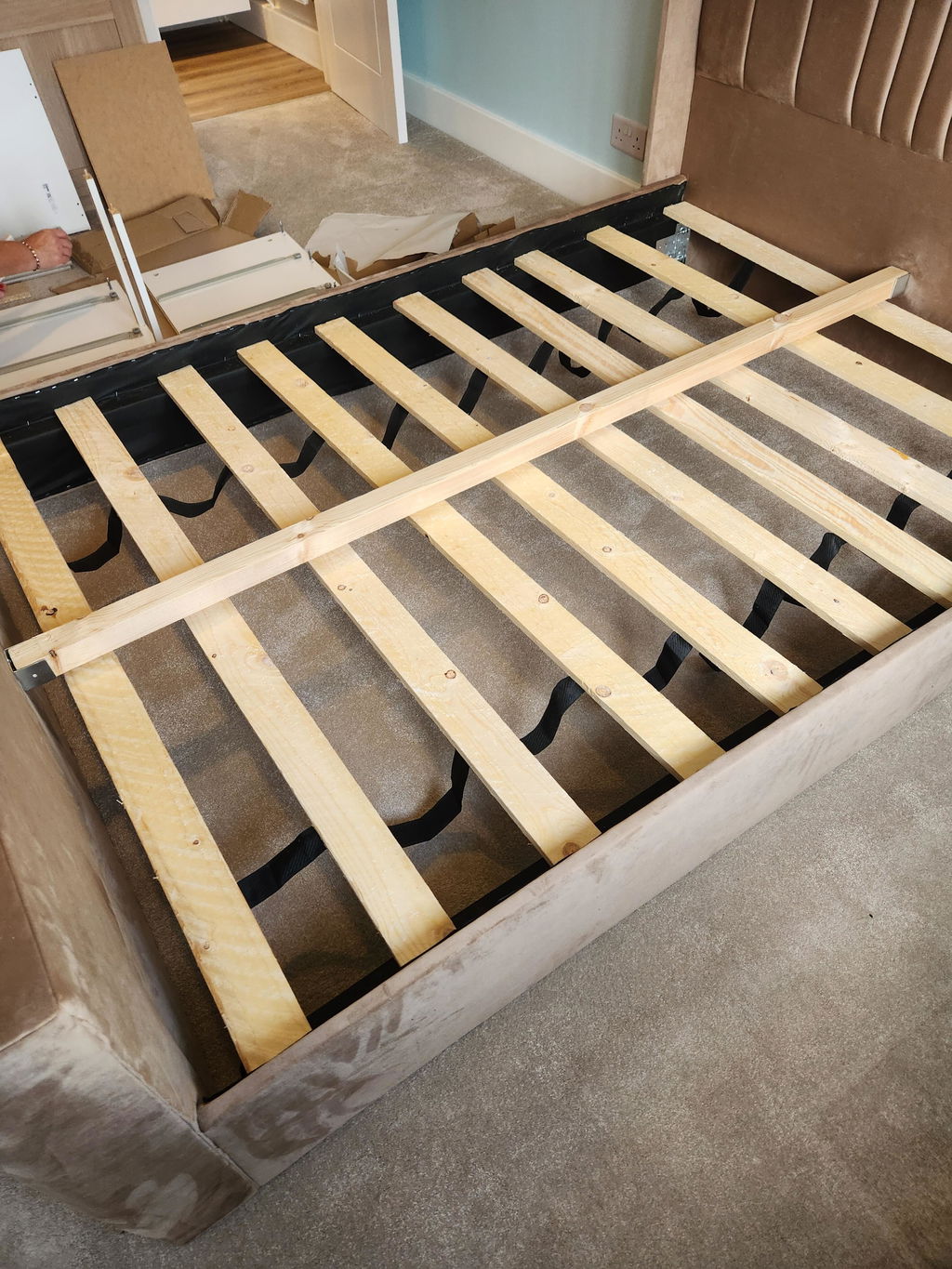
Slatted bases can work well, especially where airflow is useful. Solid slats create firmer support, while sprung slats add more flex. The risk is spacing. Mattress Online lists maximum slat gap guidance from mattress manufacturers ranging from 6cm to 9cm, with 7.5cm common across several brands. Fishpools similarly advises that slat gaps should be no more than 7.5cm, or about 3 inches.
If you have a memory foam, hybrid or pocket-sprung mattress, wide slat gaps can allow parts of the mattress to dip between supports, increasing wear and potentially affecting warranty cover.
Adjustable Electric Bases: Comfort With Compatibility Rules
Adjustable electric bases are ideal for people who read in bed, watch TV, need easier positioning, or want pressure relief in raised head or leg positions. The key point is compatibility. Not every mattress is designed to bend repeatedly. Foam, latex and selected hybrid mattresses are often more suitable than traditional rigid spring mattresses, but always check the mattress specification before pairing it with an adjustable base.
Match the Foundation to Your Mattress Type
Memory Foam Mattresses
Memory foam needs consistent support. A platform top divan, solid base or closely spaced slatted base is usually safer than a frame with wide gaps. Foam is designed to contour around the body; if the support below is uneven the foam can dip where it should stay stable.
Pocket-Sprung and Hybrid Mattresses
Pocket-sprung and hybrid mattresses are heavier than many basic open-coil mattresses. They need a base that distributes weight evenly. A divan, platform-top ottoman or high-quality slatted base can work well, but the base must be strong enough for the mattress and sleepers combined.
Latex Mattresses
Latex is naturally responsive and often heavier than foam. A strong slatted base can help with airflow, but spacing still matters. A reinforced platform base is a better choice where weight and long-term stability are the main concerns.
Firm or Orthopaedic Mattresses
Do not assume the hardest setup is automatically best. A systematic review in Sleep Health found medium-firm mattresses were beneficial for chronic non-specific low back pain and were associated with better comfort, sleep quality and spinal alignment than softer systems in the reviewed evidence.
The practical takeaway: choose a base that supports alignment without making the whole bed uncomfortably rigid. Side sleepers often need some pressure relief at the shoulder and hip; back and stomach sleepers usually need more stable lumbar support.
Measure the Room, Not Just the Mattress
UK bed sizes are standardised by name, but your room layout decides what feels practical. Common UK mattress dimensions include single at 90cm x 190cm, small double at 120cm x 190cm, double at 135cm x 190cm, king at 150cm x 200cm and super king at 180cm x 200cm.
Before choosing a base, measure the full journey: front door, hallway, stairs, landing, bedroom doorway and final bed position. This matters especially for king and super king bases. A split divan base can be the difference between a smooth delivery and a failed fit in a narrow terrace or flat.
Also leave enough walking space. MattressNextDay recommends around 60cm, or 24 inches, of clearance around the sides and foot of the bed where possible.
A Practical Checklist Before You Buy
Use this quick framework before choosing your foundation:
-
Check mattress compatibility first: confirm whether your mattress needs a solid, slatted, sprung or adjustable base.
-
Measure slat gaps: if using slats, aim for the mattress manufacturer’s guidance; 7.5cm is a common upper limit.
-
Match the base to your room: choose split bases for tight access and ottomans for storage-starved bedrooms.
-
Think about total height: base height plus mattress depth affects how easy it is to get in and out of bed.
-
Consider weight: heavy hybrid, latex and premium pocket-sprung mattresses need a stronger base.
-
Plan storage access: drawers need side clearance; ottomans need lifting space and the right opening direction.
Quality, Safety and Warranty Checks That Protect Your Purchase
A bed base should be treated as a long-term support system, not a decorative extra. Dreams’ 2024 survey found the average UK bed frame lifespan was 8.1 years, while the average mattress had been in use for 6.1 years. If the base is already older, noisy, bowed or uneven, replacing only the mattress may not solve the comfort problem.
For UK buyers, safety and compliance also matter. The UK Government’s 2025 amendment guidance confirms that the Furniture and Furnishings Fire Safety Regulations set flammability requirements for domestic upholstered furniture and that the permanent label requirement remains in place, even though display label requirements changed from 30 October 2025.
For hotels, B&Bs and other commercial settings, requirements can be higher. VisitBritain notes that medium-hazard premises such as hotels and B&Bs should use furniture and furnishings that comply with commercial fire safety standards, including BS 7177 for bed bases and mattresses.
The National Bed Federation also notes that there is no legal UK standard for mattress and divan base size tolerances, but accepted industry practice is plus or minus 20mm on stated length and width. That small tolerance is normal; a mismatch in named size is not.
Real-World Buying Examples
A couple upgrading from a double to a king-size mattress may want a reinforced platform-top divan if the mattress is heavy and the room has enough walking space. The priority is support and long-term stability.
A renter in a small flat may get more value from an ottoman base than a standard frame, because the bed footprint also becomes hidden storage. This can reduce the need for extra drawers or boxes.
A homeowner with narrow stairs should consider a split divan base before choosing a one-piece frame. The best base is useless if it cannot get into the bedroom.
A buyer with an adjustable electric base in mind should choose the base and mattress together, because flexibility and repeated movement are essential compatibility requirements.
Conclusion:
The best bed base is the one that supports your mattress correctly, suits your room and solves a real problem in your daily life. For some buyers, that means a simple platform top divan. For others, it means ottoman storage a reinforced base a split design for tricky access or an adjustable electric foundation.
The future of bed buying in the UK is moving towards smarter, more practical foundations: bases that support heavier modern mattresses, fit compact homes, improve storage and comply with clearer safety expectations. A mattress may be the comfort layer you feel first, but the base is what keeps the whole sleep system working night after night.
FAQs
What is the best base for a memory foam mattress?
A solid platform base or closely spaced slatted base is usually best. Avoid wide slat gaps because foam needs even support.
Is a divan base better than a bed frame?
A divan is better if you want a neat footprint, firm support and optional storage. A bed frame is better if you prefer a more decorative look or extra airflow underneath.
Are ottoman bases suitable for heavy mattresses?
Yes, but choose a strong ottoman with a quality lift mechanism. Heavy hybrid, latex or deep pocket-sprung mattresses need a sturdy frame and reliable gas-lift support.
Can an old bed base damage a new mattress?
Yes. A sagging, bowed or weak base can make a new mattress wear unevenly and may affect warranty cover.
How do I know if my bed base is the wrong size?
Match the named UK size first, then check actual dimensions. A small tolerance of around plus or minus 20mm is normal in the UK bed industry but a double mattress should not be placed on a small double or king base.